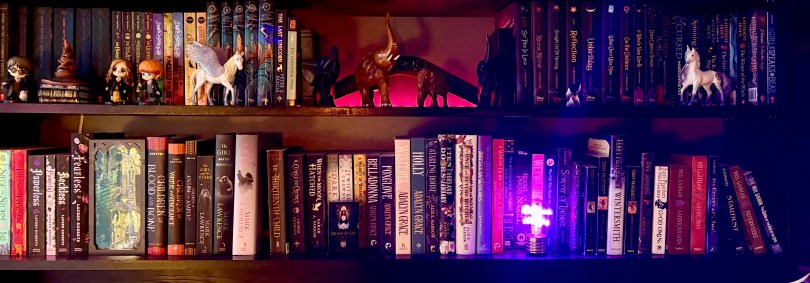
August reads, 2025

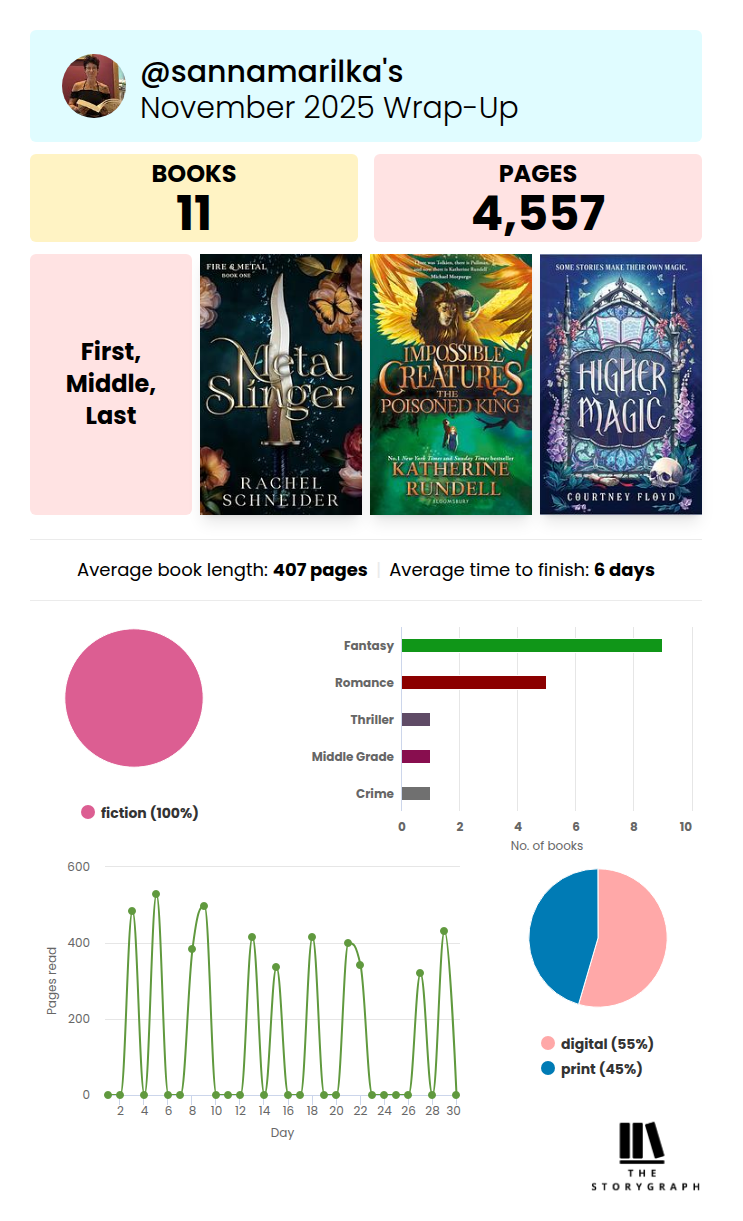
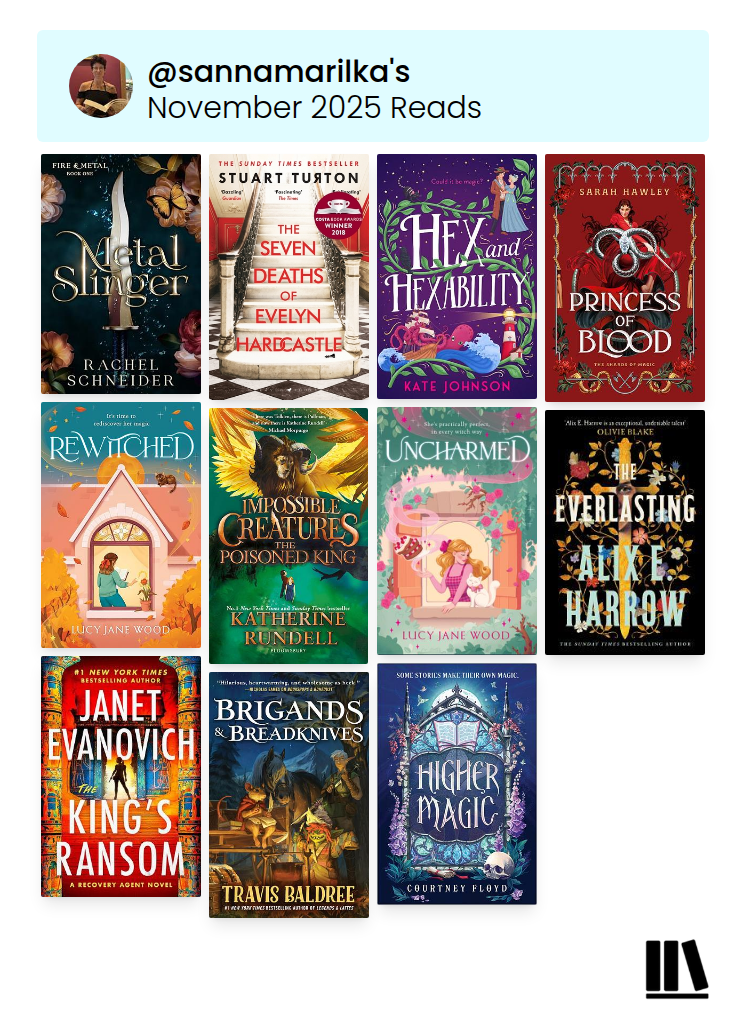
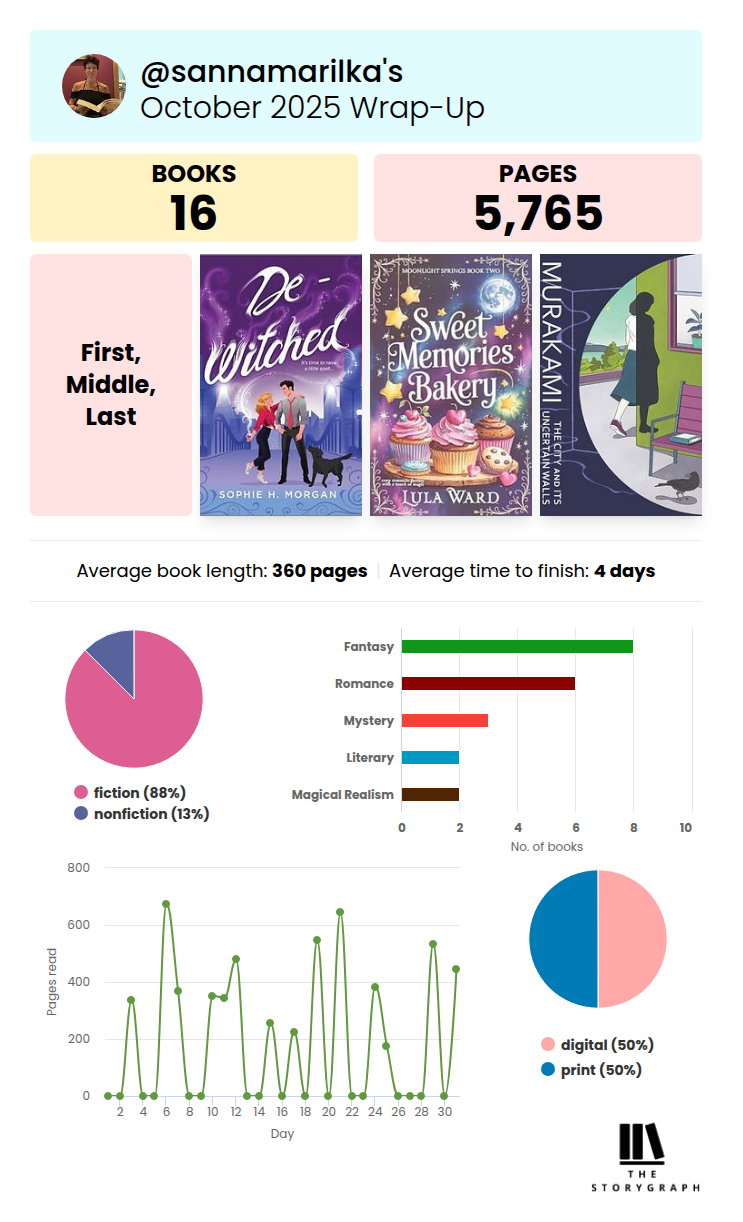
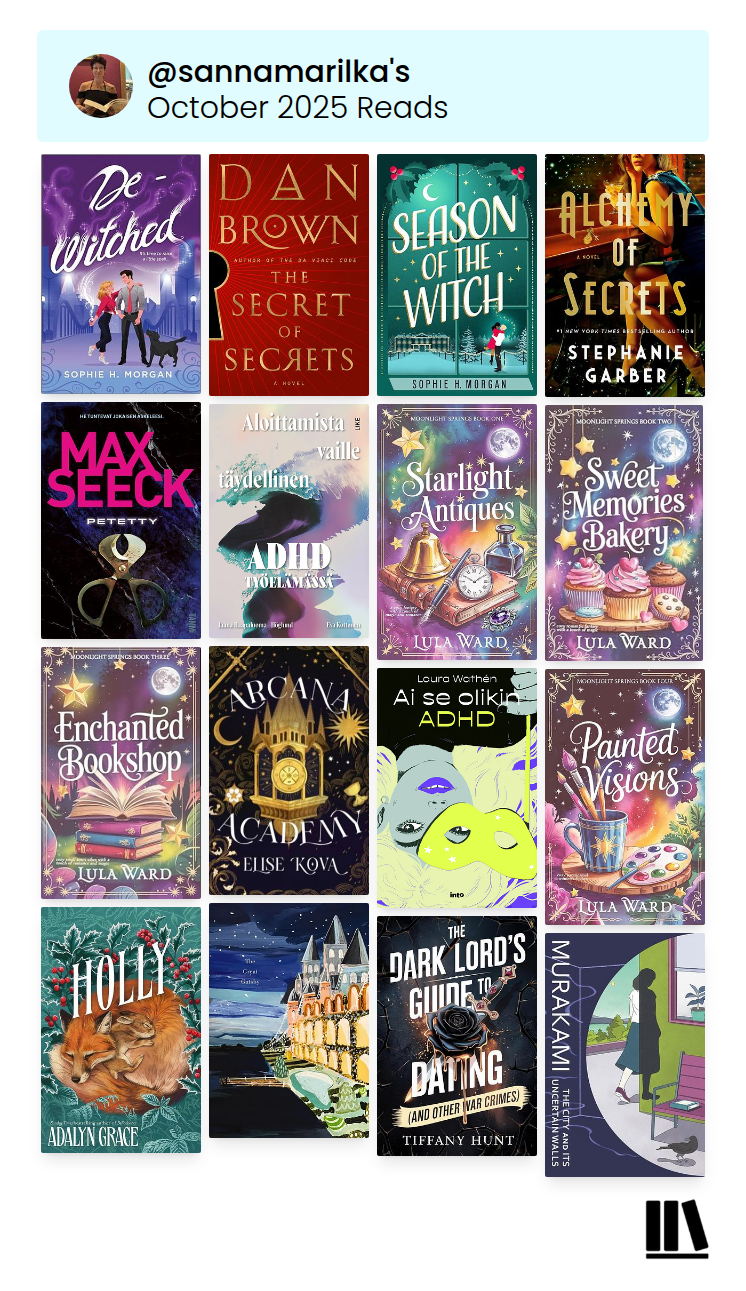
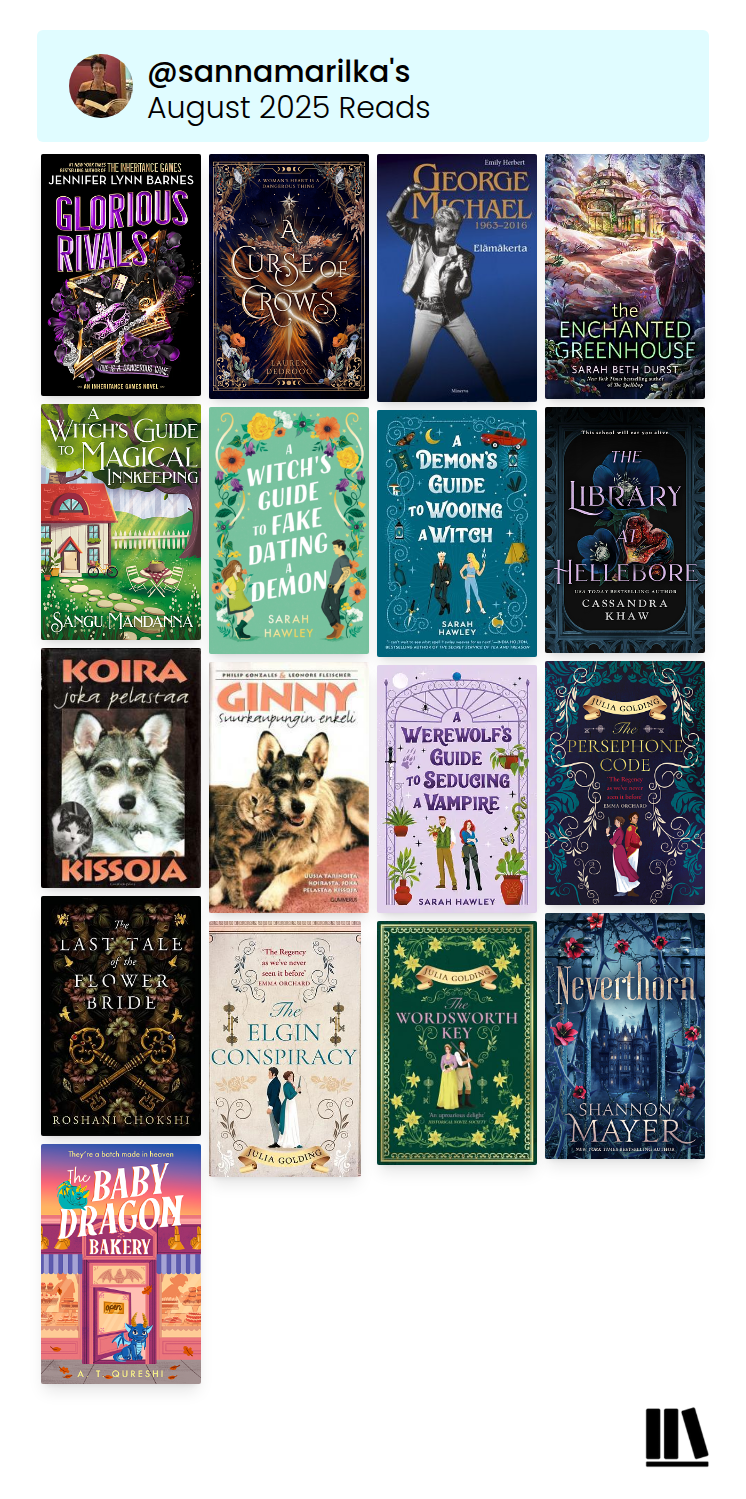
Back to work after summer holidays, and free weekends and even though I wrote a fairytale of my own (The Tale of the Twisted Tree), and did a bit of painting (Swan in Snowfall, Watching the World Burn, Hummingbird on Full Moon), I somehow ended up reading 17 books, just shy of 6000 pages. So, quite some reads to cover here, better get started:

  • Glorious Rivals (book 2 of The Grandest Game trilogy), by Jennifer Lynn Barnes – so much expected, only to (obviously) leave me on another cliffhanger in the end 😅 Such delicious suspence! Devious and clever, and now I’ll just have to wait a year for the finale.
  • A Curse of Crows, by Lauren Dedroog – first book of the A Curse of Crows and Serpents duology and I totally, fully enjoyed the book! The surprises, the secrets, the masks and facades, the fragile and sweet relationship between the protagonist and her love interest, but not void of banter and fun. Book 2 coming in the autumn.
  • George Michael: Elämäkerta (orig. The Life), by Emily Herbert – kinda like a book to read while waiting for an order to arrive 😄 Tragic life, but as a read, the book was mediocre.
  • The Enchanted Greenhouse, by Sarah Beth Durst – back to the world of the Spellshop, connected while not. Took me a while to get into the story, but then it flew and I totally loved it.
  • A Witch’s Guide to Magical Inkeeping, by Sangu Mandanna – so not disappointing! Wonderful, whimsical, heartwarming – a lovestory but also so much more. A story about finding your way Home.
  • The Glimmer Falls trilogy (A Witch’s Guide to Fake Dating a Demon, A Demon’s Guide to Wooing a Witch, A Werewolf’s Guide to Seducing a Vampire), by Sarah Hawley – surprisingly substantial examples of the genre of steamy(ish) romantacy. Mysteries, family issues, and personal growth.
  • The Library at Hellebore, by Cassandra Khaw – uh, I’d rather forget that I read the book. The sole purpose of the book was to showcase gore and disgusting stuff. So much so that I simply grew numb. Thin plot to support the, uh, gore.
  • Koira, joka pelastaa kissoja and Ginny, suurkaupungin enkeli (orig. The Dog Who Rescues Cats, and The Blessing of the Animals), by Philip Gonzales – my palate cleaners after Hellebore, sweet sweet true story that restores one’s faith in humanity. Or doganity. Or both.
  • Regency Secrets, books 1-3 (The Persephone Code, The Elgin Conspiracy, The Wordsworth Key), by Julia Golding – a bit of a Veronica Speedwell meets Robert Langdon but in the Regency era. I loved Dora and Jacob, and can’t hardly wait for book 4 (coming in November).
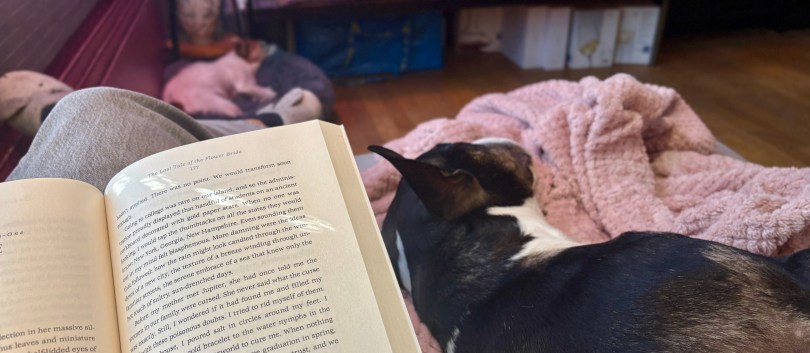
  • The Last Tale of the Flower Bride, by Roshani Chokshi – a dreamy, ethereal tale with the kind of uglyish undertone as is common for fairytales. Magic is insinuated, but never proven, leaving the reader forever guessing what is “real” and what simply the perception or fancy of the storyteller(s). I loved it.
  • Neverthorn, by Shannon Mayer – some good ole dark academy, book 1 of a duology, and gah I need to wait for a year for book 2! Actually adults (if young), and a proper plot with deception, surprises, and some bits of romance. Oh, and gotta love the frucking potty mouth rune gag!
  • The Baby Dragon Bakery (book 2 of The Baby Dragon Cafe), by A.T. Kureshi – Firends to lovers is not my thing I guess. Too much of this being too scared of ruining things to talk. I mean, I get it, but one pining already is ruining it. So when things start happening, maybe, um, talk? Also, I may be too old for 24yo immaturity (esp. the girl; the guy had shit parents so kinda excused). So, no, I didn’t enjoy this like I did the first book. Maybe book 3 with the enemies to lovers trope is more to my fancies again, I hope, bc I love this baby draggo world.

Aug 11, Every now and then you (or at least I) stumble upon the most bizzarre (I’d like to say disturbing but that would be dishonest and not quite right since I’m not actually DISTURBED at all) thing you’ve read since the previous most bizzarre thing you’ve read since… you know…

Right now that most recent most bizzarre thing is the book I just started: The Library at Hellebore by Cassandra Khaw (pic on the left), which is the most bizzare thing since I read Winterset Hollow by Jonathan Edward Durham (pic on the right) several years ago.

And by bizzarre, I don’t by any means mean bad or not good or not likeable – on the contrary. It’s good to get your mind twisted a bit now and then. So, high expectations for Hellebore – I certainly enjoyed Winterset Hollow!

Aug 16, Update: I’m a bit disappointed. The Library at Hellebore is definitely gory and then some, prolly to the point where it should be disgusting and disturbing – and I’m sure it would be if it was a movie, for the thing is that my brain does not visualize words to a level that would make anything vivid enough to truly bother me.

I find myself more like bored. Kinda like excessive chase or sex scenes bore me. Really, anything that becomes repetitive and goes on too long. The gore upon gore being most of the storyline, paired with complicated interrelational musings(also not something I endure wel), the actual plot seems thin at best, spun for the sole puprpose of offering a stage for the gruesome characters to be gruesome.

Aug 17, So, as a palate cleaner I wanted to read something heartwarming and grounding, which led me to finally reading the two books about Ginny the dog who rescues cats (The Dog Who Rescues Cats, and The Blessing of the Animals, by Philip Gonzales) which I have in Finnish because they used to belong to my grandma. I remember her talking about them and discovered that I actually gave her the other one back in !999, but just hadn’t gotten around to reading them yet. Now I did, and what a wonderful trip that was! Exactly the kind of story I needed, reminding me that there IS love and beauty in this real world ❣️

July reads, 2025

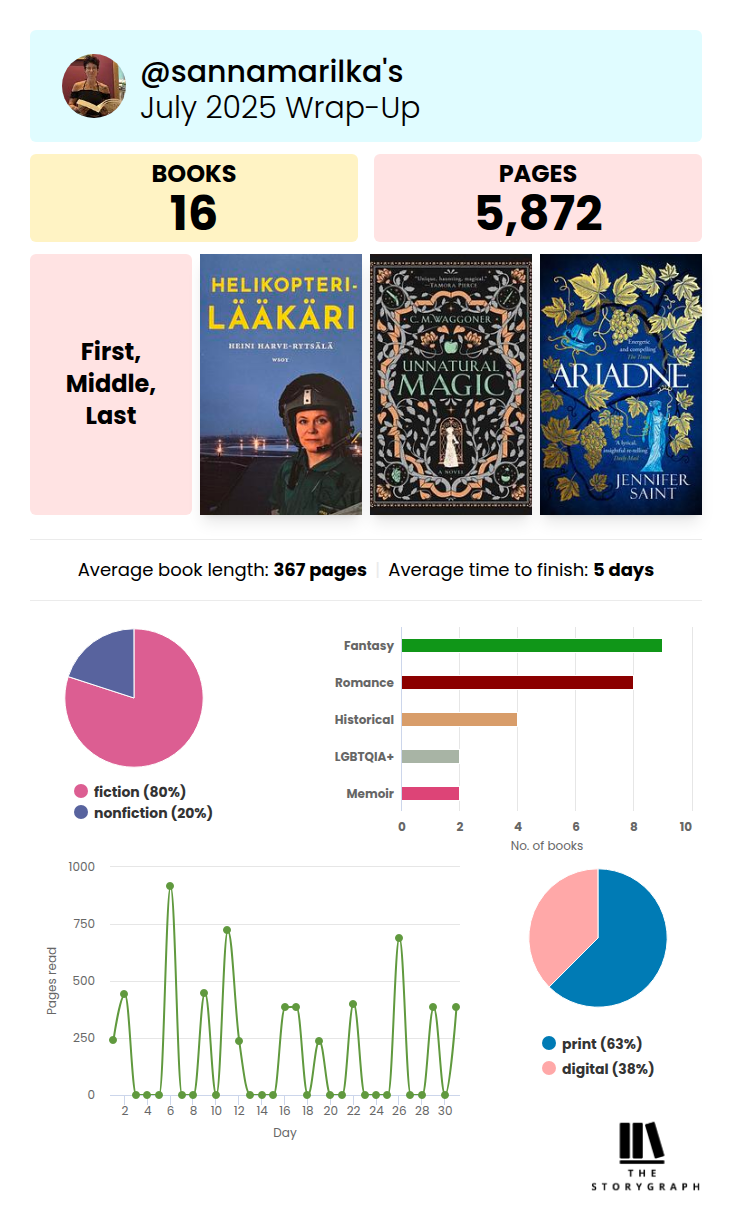
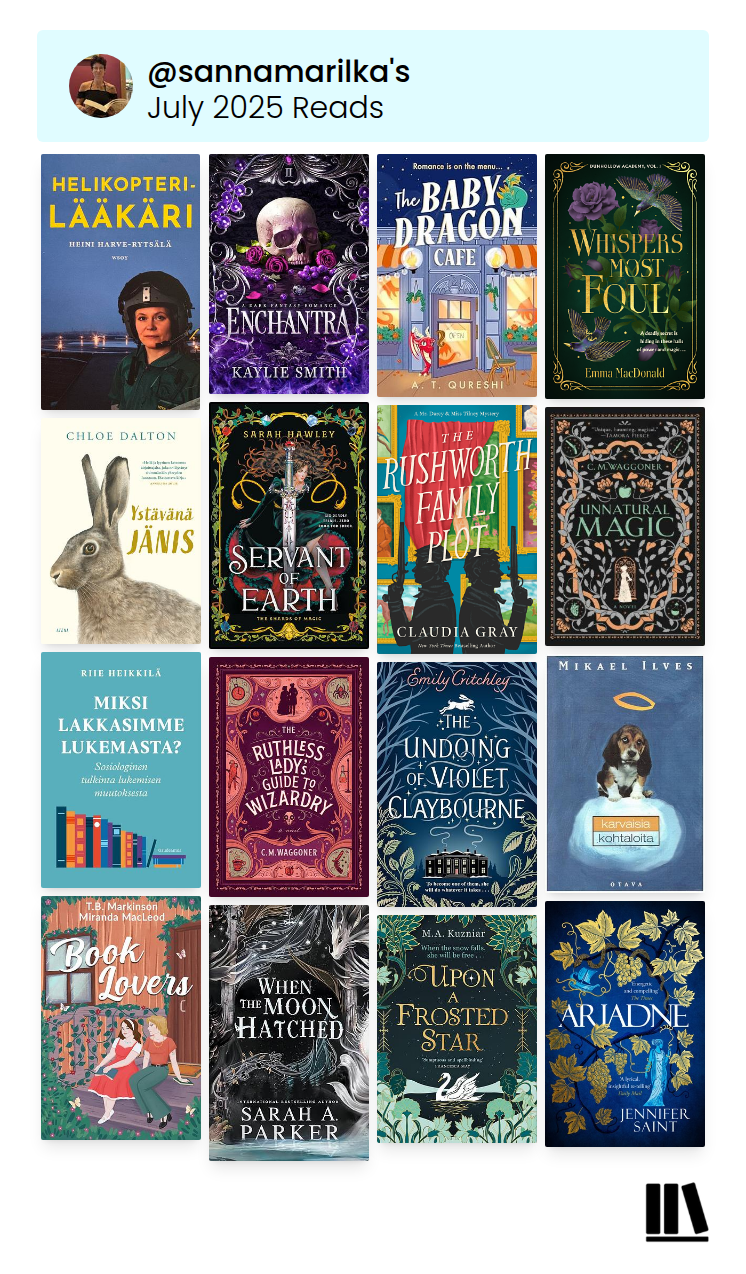
July, the summer vacation month. 4 weeks off work, and while I did a whole lot of stuff (we even had a guest for two weeks), I still found more time to read than during work days. So 16 books, a bit shy of 6000 pages. More print than digital (because more time to read during daytime since I read Kindle mostly in bed), a bit more non-fiction than average, a bit more in Finnish than average, multiple first books of a new trilogy/series. A good reading month all in all.

  • Helikopterilääkäri, by Heini Harve-Rytsälä – my goddaughter-colleague (whom I don’t know, though have met maybe a few times when we were kids) is a first-responder doctor on a medical helicopter and this is her book about what it’s like. Emotional, wonderful, heart-wreching book. I look at the yellow chopper zooming accross the sky above us multiple times a day with different eyes now, silently wishing “good luck, Heini!” every time it passes, for I know she’s on board that one on her shifts.
  • Enchantra, by Kaylie Smith – book 2 of the Phantasma trilogy, and kinda like more of the same, but not quite. A surprising ending, did not see THAT coming! Enjoyable, dark and sinister read.
  • The Baby Dragon Cafe, by A.T. Kureshi – had to take on something lighter after those previous books and this fisrt book of a magical realism (with dragons 💜) romance series was just the thing. I loved the sweetness of the book! For once people were who they said they were and families were supportive not manipulative, and you know, a hopeful and positive story with HEA.
  • Wishes Most Foul, by Emma MacDonald – dark academy with lots of magic in it. Also begins a series or maybe a trilogy, even though the book comes to a satisfying end and the next book seems to be a fully new mystery related but not dependent. Liked this one a lot.
  • Ystävänä jänis, by Chloe Dalton (orig. Raising Hare) – such a heart-warming true story of Dalton raising and befriending a baby hare without trying to tame it; she strives to maintain the hare’s ability to return to the nature. And how it all changed the way Dalton looks at the world and nature.
  • Servant of Earth, by Sarah Hawley – a fay story, kinda the usual where a young human girl ends up in the fay world one way or another and, well, you know. Needs to strive, conquer and become something more than mere human to survive. Book 1 of a trilogy, left me hanging for sure!
  • The Rushworth Family Plot, by Claudia Gray – book 4 of the Jonathan Darcy & Miss Tilney Austen-inspired mysteries. Very Austeny, witty and enjoyable, and really: will those two ever get each other??
  • Unnatural Magic, by C.M. Waggoner – we have a highly British society in a fully made up world where trolls are at the top of the food chain, and a girl whose magic it too much for the traditional men, but she doesn’t let it stop her. Also, the troll who doesn’t quite fit in, and an army deserter, and the mystery of troll killings. Curious and intriguing, verbally playful and fun.
  • Miksi lakkasimme lukemasta? by Riie Heikkilä – an academic study about the reasons people (of lower classes) don’t read (so much) anymore, and/or what they DO read. Interesting sociological study, which left me thinking and even questioning some of the study which in my opinion was still a very highlevel bare scratch of the surface, so I wrote a whole blog post about it.
  • The Ruthless Lady’s Guide to Wizardry, by C.M. Waggoner – loosely connected to Unnatural Magic, as in the love interest of the protagonist is the daughter of the troll and the soldier from the first book. A completely stand-alone mystery, which I actually liked way more than that first book.
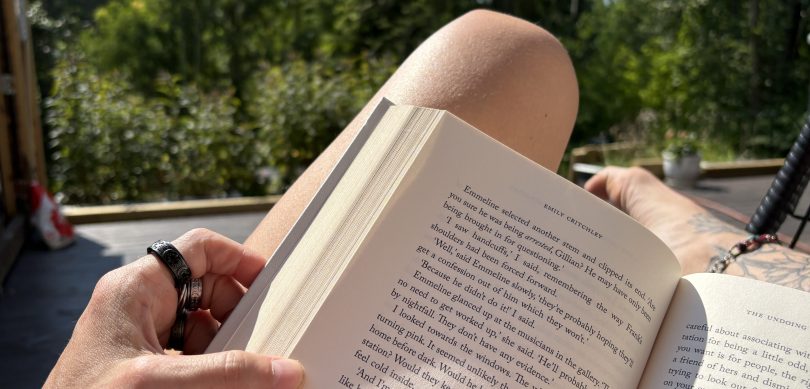
  • The Undoing of Violet Claybourne, by Emilie Critchley – a gothicy story of tragedy, manipulation, and the need to fit in, to be accepted. Sinister and full of dark secrets and ruthless schemes, that make for a story that holds you in its grips to the very end. Yes, I enjoyed it very much.
  • Karvaisia kohtaloita, by Mikael Ilves – Ilves was a veterinarian (and actually treated my grandma’s dog too and once gave a full check-up to my stuffed doggo too 😄) who saw so much that he compiled a couple books with stories of pets he treated during his career. Some of them sweet, some of them tragic (the humans!), some of them simply outrageous!
  • Book Lovers, by T.B. Markinson (and Miranda MacLeod) – literary themed story about finding love and yourself. Sweet and cute with a twist or two and a HEA, but somehow the book was constructed in a way that every 20% I was wondering how the book can still go on instead of wrapping up in a chapter or two. So maybe not exactly the most thrilling of books, but nice, to use the bland word intentionally.
  • When the Moon Hatched, by Sarah A. Parker – definitely thrilling, on the other hand. Also begins a trilogy, and left off on a cliffhanger. I have high hopes that I might enjoy the next book(s) even better, since this was one of those cases where I love the book while really not liking the protagonist much; she starts to unravel a bit in the end so maybe she’s less annoying in the next book.
  • Upon a Frosted Star, by M.A. Kuzniar – the cursed woman and the smitten artist. Loosely based on the Swan Lake. I loved the story, the slow unraveling of the history and mystery of the swan lady, but if it had been a print book, I’d have thrown it in the end. Friggin’ ending killed me! And still I went and dowloaded another book by the same author…
  • Ariadne, by Jennifer Saint – a retelling of the story of Ariadne and a bit her sister Phaedra. Of the Minotaur and Theseus, mingled in with Dionysus and a bunch of other Greek mythology. the way the stories weave into each other. Excellent book, ethereal and dreamy while full of godly mischief and tragedy.

July 6, Popping into our local bookstore yesterday I found this book, Ystävänä jänis (orig. Raising Hare) by Chloe Dalton. I have always been a huge fan of rabbits of all kinds; our home is full of them in all different forms (items, that is, not live ones; I’ve a couple live bunnies too, when I was young). Such a lovely book this is 💜🐰 a bit of an interlude between my fantasy-gorging 😄

Miksi lakkasimme lukemasta – vai lakkasimmeko?

Yleinen media- ja somekeskustelu lukemisen ja lukutaidon tilasta on täynnä huolipuhetta: huolta rapistuvasta lukutaidosta, huolta yhä vähenevästä [perinteisten kirjojen, etenkin kaunokirjallisuuden, ja lehtien] lukemisesta. Samaan maailmanlaajuisesti kirjojen kustantaminen, valikoima ja myynti ovat kasvaneet, eivät kutistuneet. Globalisaation myötä kirjat leviävät laajemmalle, digitaalinen formaatti tekee niistä helposti saatavia ilman fyysistä toimitusta, erilaiset sosiaalisen median kirjakanavat promoavat kirjoja tavalla, johon perinteinen media ei ole koskaan kyennyt. Perinteisen kirjakritiikin ja korkeakirjallisuuden ihannoinnin ohelle on tullut popularisoituneempi kirjojen vertaisarvostelu- ja suosittelu.

PISA-tutkimusten valossa on siitä huolimatta todettava, ettei huoli lukutaidon rapistumisesta ole täysin turha. Some-keskustelujen yksinkertaistettu huolipuhe on kuitenkin juuri sitä: monimutkaisen asian yksinkertaistamista. Rapistuva lukutaito ei suoranaisesti tarkoita, että lukeminen olisi vähentynyt, eikä [perinteisten kirjojen ja lehtien] lukemisen väheneminen suoranaisesti tarkoita, että lukutaito olisi yleisesti rapistunut. Vaikka nämä väittämät ja huolet siis useimmiten niputetaan yhteen, ne eivät ole syy-seuraussuhteessa keskenään, eivät ainakaan täysin. Lukemisen muutokseen liittyy huomattavan paljon enemmän kuin vaikkapa koululaitoksen syyttely.

Käytänkin itse mieluummin lukemisen trendeistä puhuttaessa sanaa muutos, kuten Riie Heikkiläkin tutkimuksessaan “Miksi lakkasimme lukemasta? Sosiologinen tulkinta lukemisen muutoksesta”.

Lukeminen itsessään on ollut valtavirran taito vasta hyvin vähän aikaa. Vielä 150-200 vuotta sitten vain kansan “ylimystö”, koulutettu parhaimmisto, korkein luokka osasi yleiseti lukea, tai ainakin riittävän hyvin, että sitä voi kutsua lukutaidoksi. Ei työläisellä oikein ollut aikaakaan lukea huvikseen, eikä kyllä kummemmin kirjoja saatavillakaan. Länsimaissa alettiin vasta viime vuosisadan alkupuolella tarjota todellinen kouluopetus, aito lukutaito mukaan lukien, kaikille alimmista luokista alkaen.

Vähän aikaa, ehkä ensisijaisest ennen television tuloa, näytti siltä, että kirjallisuuden ja lehtien lukeminen oikeasti läpäisi koko yhteiskunnan. Telkkaria ja sittemmin Internettiä olisikin helppo syyttää tästä muutostrendistä, jossa näyttäisi ainakin siltä, että lukutaito ei ole enää yhtä kaiken kattavaa kuin ennen (tekninen lukutaito kyllä on, mutta pitkän ja monimutkaisenkin tekstin ymmärtävä lukutaito ei, ja SE on se PISA-tulosten mukaan rapistunut taito). Heikkilän tutkimuksen, ja monen muunkin tutkimuksen valossa nähdään kuitenkin, ettei asia ole näin suoraviivaista. Enemmän on kyse vanhoista yhteiskunnallisista arvo- ja luokka-asetelmista, joiden olemassaolon mieluusti unohtaisimme ja sivuuttaisimme – sivuuttaminen ei kuitenkaan tarkoita, ettei niitä olisi.

Heikkilä käy tutkimuksessaan ensin läpi määrällistä aineistoa lukemisen muutoksesta erilaisten kerättyjen tilastojen ja tutkimusaineistojen perusteella. Näiden myötä hän tekee pari päätelmää:
1. Lukeminen on yhä enemmän korkeimpien luokkien juttu, kuten muukin perinteinen kulttuuriosallistuminen; matala koulutustaso ja alempi yhteiskuntaluokka johtavat todennäköisimmin vähäiseen lukemiseen
2. Internet ja televisio eivät ole suoraan johdannaisesti lukemisen syrjäyttäjiä, vaan ne kulkevat rinnakkain; paljon telkkari katsova ja vähän lukeva henkilö luultavimmin lukisi vähän joka tapauksessa, mutta telkkarin tilalla olisi jotain muuta toimintaa, ei kuitenkaan lukemista.

Tältä pohjalta Heikkilä keräsi joukon haastateltavia, joiden yhteiskunnallinen asema ja koulutustaso povasivat vähäistä lukemista. Koin haastattelujen pohjalta tehdyn analyysin hieman pintapuoliseksi, mutta palaan siihen.

Ensin haluan pysähtyä hetkeksi pohtimaan lukemisen määritelmiä ja tapoja määrällisen aineiston analyysissä. Ymmärrän, että aineisto oli kerätty muissa tarkoituksissa kuin tätä tutkimusta varten, mutta koin sen silti vähän yksipuoliseksi ja vanhahtavaksi, myös tavan käsitellä aineistoa ja puhua siitä.

Paperi vs. digi

Vaikka Heikkilä monessa kohti mainitsee eKirjat (ja äänikirjat, joiden kuuntelemisen määrittämistä lukemiseksi en ymmärrä, etenkään tieteellisessä tutkimuksessa, sillä vaikka tiedon tai tarinan kuluttaminen ko. tavalla olisi itsessään yhtä arvokasta kuin lukeminen, ei se kuitenkaan ole lukemista, mistä tässä tiettävästi oli kyse) ja digilehdet, ne kuitenkin määrällisessä analyysissä niputettiin muun Internet-lukemisen piiriin, eli samaan kastiin Facebook-kommentoinnin ja WhatsApp-viestinnän kanssa.

Ajalla ennen nettiä, lukeminen tarkoitti toki paperiaineistoja, mutta vuosituhannen vaihteen jälkeisessä ajassa on teennäistä erotella kirjojen tai lehtien lukeminen formaatin mukaan. E-kirjan lukeminen Kindlestä tai digilehden lukeminen tabletilta on minun silmissäni verrattavissa printtikirjan tai -lehden lukemiseen, ei Reddit-kommentien lukemiseen.

Määrällisen aineiston analyysistä ei ihan suoraan käynyt ilmi kysymysten asettelu – eli kun kysyttiin lehtien tai kirjojen lukemisesta, määrittikö kysymys formaatin vai ei. Toisaalta, kun vertailtiin formaatteja, annettiin “perinteisen lukijan” määritteessä hyvin tiukasti kriteeriksi että lukee paperisia kirjoja JA paperisia lehtiä, mutta internet-lukijoiksi lukeutui kuka tahansa, joka ikinä lukee sanankaan netistä, ihan sama mitä se oli. Niinpä esimerkiksi itse en lukeutuisi edes “molemmat” -kategoriaan, sillä en lue lehtiä. En paperisena, enkä digilehtiä – vaikkakin luen digilehtien artikkeleita. Olen aika varma, että tällä kovin kummallisen teennäisellä jaottelulla pudotettiin iso osa lukijoista “ei kumpaakaan” -kategoriaan, joka käsitettiin ei-lukijoiksi (siitä huolimatta, että tämä epäkohta lyhyesti huomioitiin).

Voi olla, ettei tutkimuksessa vain menty pikkutarkkoihin tasoihin asti aineiston taulukoinnissa ja käsittelyssä, sillä toisaalta Heikkilä myös toteaa, että henkilöt, jotka lukivat paljon paperikirjoja, olivat myös todennäköisempiä digikirjojen kuluttajia. Ja että pelkästään “Internet-lukijoiksi” määräytyvät henkilöt todennäilöisemmin kuluttivat muuta nettisisältöä kuin digikirjoja. Jostain tämäkin päätelmä tuli, vaikka taulukoidussa aineistossa sitä ei suoraan näkynyt.

Laadullinen analyysi

Laadullinen aineisto koostui henkilöhaastatteluista ja ryhmähaastatteluista ja Heikkilä koosti niistä heijastuvat asenteet ja lukemistottumukset kolmeen puhetapaan: hyväksyvä, käytännöllinen ja uhma. Näissä itsessään ei sinänsä mitään vikaa – näkemättä aineistosta muuta kuin valikoidut pätkät, pystyin kyllä hyväksymään päätelmät ja jaottelun. Ainakin siis esiin tuodun osuuden valossa. Kaksi seikkaa minua kuitenkin jäi analyysissä ja tutkimuksen tässä osuudessa vaivaamaan, kaksi seikkaa, jotka mielestäni tekevät tutkimuksesta hieman vajavaisen ja pintapuolisen ja ehkäpä vähän haetun:
1. Vaikka kirjassa ja määrällisessäkin analyysissä huomioitiin perheen merkitys henkilön lukutottumuksille, ei tätä aspektia huomioitu laadullisessa analyysissä lainkaan.
2. Heikkilä pyrki analyysissään sitomaan havaintonsa ja tuloksensa aikaisempaan kulttuuri- ja yhteistkuntatutkimukseen, mikä itsessään hyvänä ja ymmärrettävänä minusta johti kuitenkin hieman teennäiseenkin negatiiviseen näkökulmaan.

Perhetausta vs. puhetapa

Haastateltujen henkilöiden taustoista ei puhuttu kuin heidän oman historiansa osalta, mutta Suomen kaltaisessa maassa, missä yhteiskuntaluokat eivät ole ihan niin suoraviivaisia kuin monessa muussa maassa, voi linja-autonkuljettajan vanehmmat olla akateemisesti koulutettuja tai yliopiston tutkijan vanhemmat linja-autonkuljettajia. Lapsuudenperhe on voinut olla kirjakeskeinen ja lukemista edistävä tai sitten ei, luokasta riippumatta.

Poissaolollaan loisti myös itse asiassa henkilöiden oman taustan osalta neuro-psykologiset tekijät, kuten neurodiversiteetti tai lapsuuden traumaattisuus tai muut mielenterveyden haasteet, jotka kaikki voivat vaikuttaa niin lukemishalukkuuteen kuin siihen asennoitumiseenkin.

Ehkä nämä katsottiin tutkimuksessa toissijaisiksi seikoiksi – sillä miten ja miksi henkilö on päätynyt alhaiseen koulutustasoon ja alempaan yhteiskuntaluokkaan ei tutkimuksessa ollut merkitystä. Minua itseäni olisi kuitenkin kiinnostanut näiden mahdollinen vaikutus henkilön lukutottumuksiin ja asenteeseen, ts. tutkimuksen kannalta puhetapaan, johon henkilö lukeutui. Oliko taustoissa nähtävissä trendejä – yhdenmukaisuuksia saman puhetavan sisällä, selkeitä eroja eri puhetapojen välillä?

Sosiaalinen erottautuminen

Heikkilän pyrkimyksessä kiinnittää tutkimuksensa tulokset aiempiin kulttuurisosiologisiin tutkimuksiin, hän käytti välineenä sosiaalisen erottautumisen, eron tekemisen, mekanismeja ja teorioita. Jokaisesta puhetavasta hän kaivoi, välillä hieman väkisinkin, esiin miten puhetavan edustajat tekivät pesäeroa ylöspäin tai alaspäin. Miten hyväksyjät puhuivat väheksyvästi juorulehtien tai viihdekirjallisuuden lukemisesta tehden näin eroa alaspäin, kun taas uhmakkaat puhuivat väheksyvästi kaunokirjallisuudesta tehden eroa ylöspäin, ja käytännölliset vähän molempia pelkästään sillä, että määrittivät lukemisensa “mun juttu”-lukemiseksi (samalla hyväksyen kaikille muille omat tottumuksensa, mutta leimaamalla “ei-mun-juttu”-lukemistot tylsiksi tai turhiksi).

En sano, että kaikki eronteko olisi ollut teennäisesti määritettyä. Etenkin ääripäiden retoriikka toi erottelut esiin hyvinkin selkeästi. Toisaalla tuhahdeltiin Harlekiini-kirjojen lukijoille, toisaalla naureskeltiin Aleksis Kiven lukijoille. Toisaalta pidettiin Tolstoin lukemista tai ainakin omistamista “tietenkin”-selvyytenä, toisaalla vitsailtiin sen kustannuksella, joka kehtasi tarjota luettavaksi mitään Biltema-luetteloa monimutkaisempaa.

Kulttuurisesti ja yhteiskunnallisesti tällainen erottautuminen ja sosiaalinen rajanveto on sosiologinen fakta ja tunnistan sen toki omassa elämässäni ja elinpiirissäni ihan yhtä lailla. Sosiaaliset luokat pyrkivät erottautumaan tosistaan määrittämällä, mikä on oikeaa ja mikä on hyvää ja miten tulee olla, mikä on esteettisesti ja moraalisesti luokan mukaista. Tätä erottelua ja määrittelyä ei tee vain korkeat luokat vaan alimmat luokat yhtä lailla. Ja toisaalta molemmissa luokissa on niitä, jotka pyrkivät tasa-arvon tai jonkin muun nimissä mukautumaan eri luokkaan kuin mihin muiden seikkojen valossa kuuluvat.

Väitän kuitenkin että väliin mahtuu paljon heitä (meitä), jotka luokkavapaasti arvottavat asioita hyvin henkilökohtaisesti, vailla pyrkimystä sen paremmin mukautua yhteen luokkaan kuin tehdä eroa toiseen. Käytännöllisen puhetavan henkilökeskeisyyden lukeminen erottautumiseksi molempiin suuntiin olikin mielestäni varsin teennäinen ja negatiivinen, vanhanaikainenkin, tulkinta. Se, että henkilö haluaa lukea sitä mikä kiinnostaa, muttei sitä minkä kokee pitkäveteiseksi ja tylsäksi, ei tarkoita että happamia sanoi kettu pihlajanmarjoista vaan että henkilö haluaa lukea sitä mistä tykkää.

Ehkä otin tämän hieman henkilökohtaisesti, myönnän, mutta olen hyvinkin vakaasti sitä mieltä, että lukemisen tulee olla nautinto. Että jonkun kirjan lukeminen vain siksi, että joku on joskus päättänyt sen olevan jotain toista kirjaa arvokkaampi, ei ole itseisarvo. Lukeminen on itseisarvo, ja monipuolisesti omien kiinnostusten mukaan lukeminen on itseisarvo. En itse lue mitään vain kuuluakseni johonkin korkeakirjallisten joukkoon, koska yhteiskuntaluokkani ja -asemani noin periaatteessa minut sinne asettaakin. Kenenkään ei pitäisi pyrkiä nostamaan tai laskemaan itseään lukemisellaan. Ehkä jo tämän arvottamisen vähentäminen nostaisi monen halukkuutta lukea ylipäätään mitään kirjallisuutta.

Edelleen tutkimuksessa häiritsi se, että se nojasi niin vahvasti tähän vanhahtavaan kulttuuriosallistamisen kirjallisuusjakoon, missä kaunokirjallisuuden lukemista arvotettiin jo tutkijan näkökulmasta “populaarikirjallisuutta” korkeammalle. Tietokirjallisuuden suhteen tutkimus oli jotensakin neutraali. Ehkä olen tässäkin taas subjektiivinen, fantasian suurkuluttajana, mutta väitän lukevani ja lukeneeni sen verran monipuolisesti kaikkea, että minulla on jonkinlainen mandaatti todeta, että genre itsessään ei mitenkään välttämättä määritä kirjan monitasoisuutta, kompleksisuutta tai laatua.

Oma loppukaneettini

Vaikka tämä tutkimus oli jo huomattavasti yleistä “huolipuhetta” monipuolisempi ja moniulotteisempi, sekin yhä keskittyi hyvin perinteisiin sosiologisiin ja kirjallisiin rakenteisiin analyyseissään ja johtopäätöksissään. En ehkä itse näe Bilteman luettelon, WhatsApp-chattien ja Facebook-kommentoinnin lukemista saman arvoisena lukemisena kuin edes blogien lukemista, mutta toivoisin silti koko lukemiskeskusteluun enemmän avaruutta.

Niin kauan kuin kirjoja arvotetaan teennäisin perustein, niin kauan kuin lukemista arvotetaan oikeanlaiseen ja vääränlaiseen, oikeiden ja väärien aineistojen lukemiseen, siihen aina liittyy niin arvolatauksia kuin luokkalatauksiakin. Niin kauan kuin ylhäältä käsin kerrotaan, mitä jokaisen tulisi lukea, synnytetään vastareaktioita. Koulussa jo olisi hyvä ohjata oppilaita löytämään sellaista lukemistoa, joka kiinnostaa, ja tukemaan heitäkin, joille lukeminen on vaikeaa “teknisistä” (lukihäiriöt, neurodiversiteettiin liittyvät haasteet, ym) syistä, arvottamatta materiaaleja, luetun pituutta tai monimutkaisuutta sinällään.

Lukutaito on arvokas ja tärkeä taito, ja sen säilymisestä on syytäkin pitää huolta. Kaikista ei silti tule kirjojen tai lehtien suurkuluttajia, eikä tarvitsekaan. On eri asia osata lukea pitkiä ja monimutkaisia tekstejä, ymmärtäen lukemansa, kuin nauttia lukemisesta ja harrastaa sitä vapaa-ajalla. Niin paljon kuin itse arvostan nimenomaan lukemista, objektiivisesti on todettava, ettei kirjojen tai muiden materiaalien kuunteleminen ole sen vähempiarvoista itse materiaalin kuluttamisen kannalta – ja mitä pitemmälle ajassa mennään, sitä epäolennaisemmaksi todennäköisesti tulee kuluttamisen muoto versus kyky ymmärtää sitä.

June reads, 2025

My June weekends were mostly full of all sorts of things like hosting a birthday (my own, round 50) 🎂, hunting for a fridge (old side-by-side started dying, see A Tale of Two Fridges), shopping with my daughter 💜, and some reno-related stuff I don’t even have the energy to get into. Surprisingly enough, I still seem to have found time to read almost as much as any other month. June reads were a mix of long-awaited sequels and new releases from favorite authors, and some completely new finds.

  • A Letter from the Lonesome Shore, by Sylvie Cathrall – I loved this sequel to A Letter to the Luminous Deep ❣️ The same ethereal ambiance, some twists and turns and a happy ending.
  • Everybody Wants to Rule the World Except Me, by Django Wexler – Sequel to How to Become the Dark Lord and Die Trying. Fun and gamey, but a bit more of a serious undertone as life for Davi is not a game anymore. Mysteries are unraveled and yes, this book too has a happy ending.
  • The Amalfi Curse, by Sarah Penner – A superb witchy realism story where past meets present and romance wins.
  • The Haunted Housekeeping series (4 books), by R.A. Muth – Funky, quirky cozy mysteries with just a touch of supernatural and magic. A bit “easy” reading for my liking.
  • Fearless, by Lauren Roberts – book 3 in the Powerless series (the final one), which was, well in line with the other ones, but liked it somewhat better again than the first one. I think Book 2 was my favorite in this trilogy (series – as it has a book 1.5 which I somehow didn’t feel like reading even though I have it).
  • The Resurrectionist, by A. Rae Dunlap – Historical gothy fiction from a time when autopsies were considered sacrilege, but the more advanced though hushed Parisian syle training, ie. hands on and cutting corpses open, was in need of bodies to work on. Also, forbidden gay romance 💜
  • The Mysterious Bakery on Rue de Paris, by Evie Woods – magical realism romance, sweet and heartwarming, while quite predictable.
  • Bury our Bones in the Midnight Soil, by V.E. Schwab – Three vampire women, destiny tied together in a way that is not entirely guessable in the beginning. Intriguing travels through centuries, stopping here and there for a bit longer to shed light on the evolution of the characters.
  • Phantasma, by Kaylie Smith – Not quite as enchanting as I expected, not quite as ingenious as I hoped. More like a “everything tries to kill you and you just need to survive (though you’re really not up to the task)” kind of a story than witty and puzzly, like I’d prefer. Quite enjoyable none the less, and now I’m a bit past the half mark on the sequel, Enchantra (which is more of the same while different).
  • Enigma, by RuNyx – I absolutely love RuNyx and her way of weaving these dark romance mysteries. Full of twists and turns and secrets to unravel bit by itty bit, clues to tickle your brain and lead you astray, passion, even obsession (which maybe is not my thing, but I can accept it here). Can’t wait to get more RuNyx!

June 1, Finally, finally reading (well, started already yesterday) A Letter from the Lonesome Shore, by Sylvie Cathrall 🤩 I loved the first book, A Letter to the Luminous Deep; this sequel is one my most anticipated reads of the year!

June 14, Started the fourth book of The Haunted Housekeeping, by R.A. Muth, series last night. While the books are kinda funny and quirky – enough to keep me reading through them all, especially when they’re not very long – they are a bit simple to my liking. I realize cozy mystery (even with a paranormal/fantasy/magical realism twist) is just not my cuppa. Things are too easygoing, a bit lame and simple. I want some actual suspense, gory bloody gruesomeness and such. Go figure.

A Tale of Two Fridges

Once upon a time 8 years ago we bought a side-by-side fridge-freezer that first stood in our living room for a month or two, or hell who remembers? Maybe even four. When the kitchen reno was more or less done, we moved the fridge to the kitchen, with a whole lot of huffin’ and puffin’ and cursin’ – and apparently removing and reinstalling the doors.

For 8 years, that frigde served us, with a problem here and another there, with signs that it might not be the most longlasting one ever, but little did we anticipate that after only 8 years, it would start breaking down. Perhaps we should’ve seen the signs, but we ignored them, in the hopeful way people ignore signs of impending doom. Until one day it started making a *noise*. Like a helicopter taking off. Uh-oh! Not good!

We tried defrost it, leaving it unplugged for a time, messing with the fan, you know, attempting to fix it, thinking that if it’s just got some ice there somewhere, it’s not fatal. After a few days it became clear that it was, indeed, fatal. Or at least could be assumed to be. Nothing helped, the noise kept getting worse. Auto-defrost was caputt. Ice cubes became a clump. Walls started to ice up. Fan sometimes didn’t work at all, sometimes sounded like a damned Apache flying in our kitchen.

So, we did what any reasonable people would do: we looked for a replacement. Not too many requirements really, just that it should be a similar machine. Side-by-side fridge&freezer, with an ice cube dispenser without plumbing (with water tank), full doors (not split cabinets), and not wifi/smart controlled. Turns out this last requirement was the hardest one to come by with the overall specification. We found one model. ONE. O.N.E. 1. Yes, we like a smart home, but we don’t want our appliances online.

It was the Thursday last week, two days before my 50th birthday party (if cake and coffe with a handful of family members can be called a party, but, you know), when I tried to order the fridge online. No problem per se, but I could only get the delivery options of out to the curb or through the door, end of story. So, what about taking the old one away? Getting the ginormous machine “installed” into its place? Oh, and we’d need a new flood matt thingy too! Helpful chatbot told me to go to a store. Groan.

So, with all the birthday baking and guests (family) and whatnot, Sunday was my designated fridge shopping day, fingers crossed the old one holds on a few days longer. Friendly sales dude made the order for me, all required delivery etc. option included and I selected a delivery time: upcoming Wednesday, 16-19. First one available that was ok for me too. Paid myself out of the store and happily set back home, fingers still crossed, glad to get the machine before the Midsummer’s three-day weekend knocking on our doors.

Come Wednesday, I’m at the office for most of the day, waiting a bit impatiently for the comfirmation of the more exact delivery time. Until finally my phone buzzes (well, actually, only my watch buzzes, phone is dead silent, just as I like it) with an SMS from the delivery company: your product will be delivered between 19:30 and 21:30 tonight. Wot?! Fuck. But ok, it’s a bit late, but ok. I leave it at that, figuring I’m not in such a hurry to get home from the office, after all.

I leave around 15:30, and right at that point I get another SMS, this one instructing me to select a delivery time for my product. I check the offered time slots: MONDAY June 23rd! What the actual fuck?! So I call the customer service and a friendly sympathetic dude tells me that yes, they are only delivering the flood protector matt today. WOOT!?!! He listens patiently as I rant about a dying fridge and “what the fuck do I do with the flood matt only? It won’t keep our food frozen or cold if the old machine dies during Midsummer!” “No, it won’t, you of course should get the fridge at the same time”, he agrees good-naturedly and promises to see what he can do to schedule the fridge delivery for tomorrow, ie. today, Thursday.

A bit later he sends an SMS informing me that he can’t confirm Thursday delivery yet, but will do his best the next day. Fine. Can’t do much other than wait and hope for the best, and turn the sound on on my phone and Sleep mode off, just to receive that darn piece of plastic in the evening. And rant and rage to Husband in a half-way melt-down manner until he snaps that he can’t take my shit no more, can you please just shut the fuck up already – there’s nothing you or I can do about it!

Fine. I grumble and am pissed off for the rest of the evening, and grouchily open the door to the guys bringing that friggin’ matt. “Two guys to deliver a sorry ass plastic matt!” I exclaim upon seeing all two of them holding the thing up to me. I go on to tell them how I fully expected to get my fridge tonight but something somewhere got messed up. “And no, not your fault I know, just complaining, you know.” “Well, we could take some measurements here, to see how the space is here, for the delivery”, the one guy says after seeing our sort of tight doorways, and promptly takes out a tape measure and starts measuring.

“Hmm, the fridge won’t fit through the doorway here. Nor does the old one fit out.” “Fuck-vittu! We totally forgot that we needed to take the doors off when bringing the fridge in, now I vaguely remember! I guess same needs to be done now.” “Hmm, we can’t do that without you clearing it with the seller first, because it probably cancels all warranty.” Some more discussion about the topic and a note about potential problems upon delivery and the guys bid me farewell and I descent to the bedroom to give the happy news to H. “We’ll take the doorframe out. Problem solved.” Fine, ok, whatever. I call the dude to tell him to note that problem will be solved before delivery.

And so it its. First thing this morning the frame is removed, leaving a crumbling cement wall on one side of the doorway, exposed red brick on the other. And a couple hours later the chipper customer service dude calls to tell me we’ll get our fridge today, delivery tom 14-16, “you’ll get a call half an hour before”. Yey! By 15 I am upstairs reading, still no call. Then 15:10 incoming: “we’ll be there in 10 minutes”. Um, ok! I better get busy emptying the fridge&freezer into coolers then! Chop chop!

15:20 on the dot they are here to take the old fridge away, first, obviously. Off comes the foyer door, too, to make more space. No problems with that part. Then they roll in the new one, in it’s full packaging. The try to squeeze the thing through the kitchen doorway, resulting in chunks of cement flying off the crumbling side. “Why are you taking it there in the cardboards? You need to take it out first!” “Well, but that is installation, it hasn’t been paid, so we can’t unpackage it. Now wait a minute sir! I full well paid for installation! Read the fucking receipt!

Dude reads the receipt and grudgingly agrees that there it is, takes a photo of it. They proceed to unwrap the beast, and set it on its floodmatt, and start hauling the packaging garbage out. “So, that’s it then, I guess,” the one guy says, the other one is already back at the truck. “Hold on! The door! We can’t get it back by ourselves!” So he grabs the door, fails alone, and hollers his pal to help and they get the door back in place, and take their leave.

We go into the kitchen, look at our new fridge&freezer, deciding that we actually like that black metal better than the silver-gray old one. But damn there’s a lot of tapes and plastics still in place! So the installation does not include getting all of that out. Fine, whatever, we set to work, and have our new machine plastic-free and filled with out groceries, humming practically soundlessly (yeah, conundrum, but what ever), cooling down with super-freeze and super-cool turned on.

So, same hopscotch 8 years from now? One would hope it’s not a trend, and this one would be a bit more long-lasting than that…